Building an epigenetic biohacking plan now means that once you do get test results, you’ll be able to confidently plug in the details and fine-tune like a pro. 🧬✨
Let’s break it into three key parts to set you up:
🧭 PART 1: The “Before” — Planning Without Test Results
Here we create a strong foundation so you’re not flying blind. This is your baseline biohacking blueprint, focused on the pillars that improve any epigenetic profile.
🎯 Step 1: Define Your Goals
Even without lab data, you can guide your plan by targeting things like:
- Lowering your biological age
- Increasing energy and focus
- Reducing inflammation
- Enhancing cellular repair and recovery
- Supporting healthy hormones
- Optimizing brain function and stress resilience
Keep the big picture in mind: live longer, feel younger, function better.
🧱 Step 2: Build Around the Epigenetic Pillars
These six pillars are your “control knobs” — the big levers that epigenetic testing most often reflects:
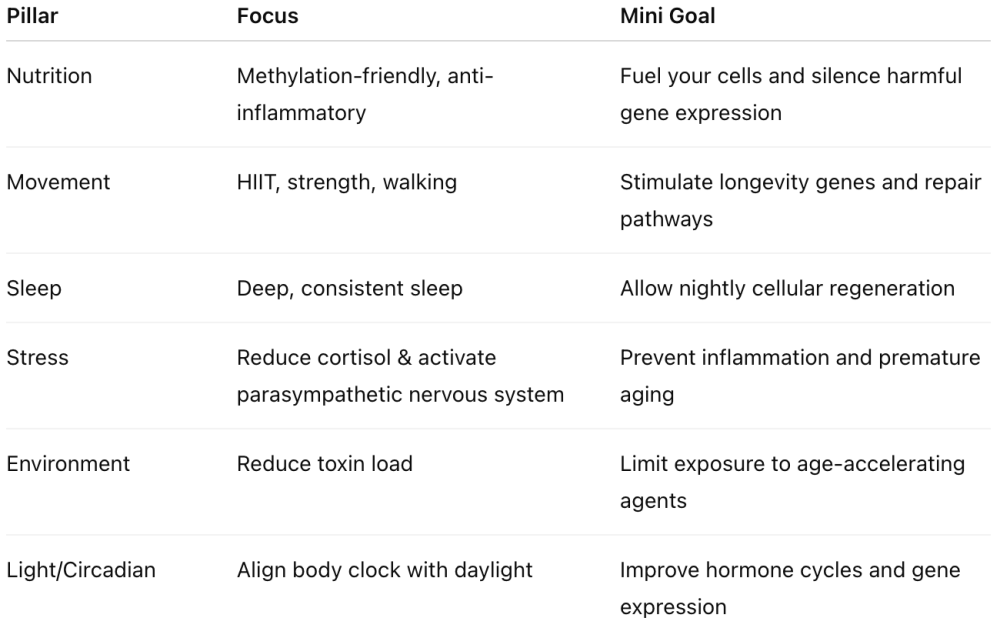
You can begin optimizing all six before testing, knowing they universally support gene expression.
🔬 PART 2: What to Look For in Your Epigenetic Test Results
Once you’ve got your results, you’ll want to look at these four core readouts (the exact names may vary by provider):
1. Biological Age
- Compares your cellular age to your calendar age.
- Lower = good. Higher = cue the broccoli and dumbbells.
2. Pace of Aging
- Shows how fast you’re aging right now compared to average.
- Think of it as your biological “speedometer.”
3. Methylation Markers
- These are site-specific tags that influence gene expression.
- May reveal inflammation, detox capacity, stress responses, metabolic patterns.
4. Lifestyle Scores
- Some reports break down scores by domain (sleep, exercise, diet, toxin exposure).
- Use these like dials you can turn up or down.
Optional bonus markers (if included):
- Telomere length (related to cellular lifespan)
- Inflammatory gene expression
- Immune system “age”
- Hormone-related gene [removed]especially for women)
⚙️ PART 3: How to Interpret & Adapt Based on Your Results
Once you see the numbers, here’s how to build your next steps:
🎯 If Biological Age is High:
- Prioritize nutritional overhaul (methylation support + inflammation reduction).
- Add more structured, regular exercise (especially resistance and HIIT).
- Consider polyphenol supplements (curcumin, green tea, etc.).
- Recheck in 3–6 months.
🚦 If Pace of Aging is High:
- Double down on stress reduction (daily breathwork, meditation).
- Improve sleep hygiene — even a 30-minute earlier bedtime helps.
- Look into toxins or pollutants you may be unknowingly exposed to.
- Add adaptogens (ashwagandha, rhodiola) or HRV tracking to enhance resilience.
💥 If Inflammation Markers Are Elevated:
- Shift to an anti-inflammatory diet (rich in omega-3s, no ultra-processed foods).
- Avoid alcohol, manage blood sugar, increase fiber.
- Try time-restricted eating and/or gut-healing foods.
🧽 If Detox Genes Look Sluggish:
- Support liver: leafy greens, cruciferous veggies, milk thistle.
- Hydration, sauna/sweat, Epsom salt baths.
- Consider activated charcoal or glutathione (if advised).
🌙 If Circadian Rhythm Genes Are Misaligned:
- Reinforce light/dark cues daily.
- Use morning sun and nighttime dimming to reset clock.
- Avoid screens after 9 p.m., get blackout curtains or eye masks.
🧪 Your Epigenetic Biohacking Framework
Here’s how to think of the full cycle:
- Phase 1: Prep (now)
→ Start your foundational practices (the 30-day reboot is perfect here) - Phase 2: Test
→ Choose a testing company that offers biological age + methylation analysis - Phase 3: Adapt
→ Compare results to your goals and tweak your habits accordingly - Phase 4: Retest
→ Aim for 3–6 months later to track your progress and make it tangible