🎟️🧬 Here are some of the top testing options out there, with their benefits and drawbacks so you can pick the one that vibes best with your goals and budget.
🧪 Popular Epigenetic Testing Options Overview
1. TruAge by TruDiagnostic
Overview:
- One of the most respected and research-driven epigenetic tests.
- Uses saliva or blood samples to analyze DNA methylation and biological age.
- Offers detailed reports on biological age, pace of aging, inflammation markers, and more.
Benefits:
- Research-validated with large datasets.
- Highly detailed reports with actionable insights.
- Offers ongoing updates and new metrics as science evolves.
- Option for longitudinal testing (track progress over time).
Drawbacks:
- Pricey (~$300–$400 per test).
- Sample collection can be a bit involved (blood draws at a lab for best accuracy, or saliva at home).
- More data than some casual users might want—can be overwhelming.
2. EpiAge by MyDNAge
Overview:
- One of the earlier epigenetic age tests, often offered through partner labs.
- Usually requires a blood draw.
- Provides biological age and methylation age estimates.
Benefits:
- Established and reputable in academic research.
- Accurate biological age calculation.
Drawbacks:
- Less consumer-friendly interface.
- May require lab visits.
- Reports tend to be more basic with fewer lifestyle insights.
3. Chronomics
Overview:
- A UK-based company offering a saliva-based epigenetic test.
- Focuses on biological age, lifestyle factors, and wellness markers.
- User-friendly online dashboard.
Benefits:
- Non-invasive, easy at-home collection.
- Integrates lifestyle questionnaires with biological data.
- Ongoing updates and personalized coaching options.
Drawbacks:
- Biological age estimate less granular than some competitors.
- Limited availability outside the UK (though shipping options may exist).
4. DunedinPACE (via select providers)
Overview:
- Measures the “Pace of Aging” — how fast your body is aging right now.
- Often bundled into more comprehensive tests (like TruDiagnostic).
- Gaining attention in longevity circles for being a sensitive, dynamic biomarker.
Benefits:
- Sensitive to short-term lifestyle changes.
- Great for tracking progress over months.
Drawbacks:
- Usually not sold standalone — you get it as part of a bigger test.
- Limited consumer-facing interpretation guides.
5. 23andMe + Third-Party Analysis
Overview:
- 23andMe does genetic testing (your fixed DNA), but you can upload raw data to third-party apps that estimate epigenetic age using predictive models.
Benefits:
- Very affordable or already done for ancestry.
- Easy to access and use.
Drawbacks:
- Not a true epigenetic test (doesn’t measure methylation).
- Results are estimates, less accurate and less actionable.
🧩 Choosing What’s Right for You
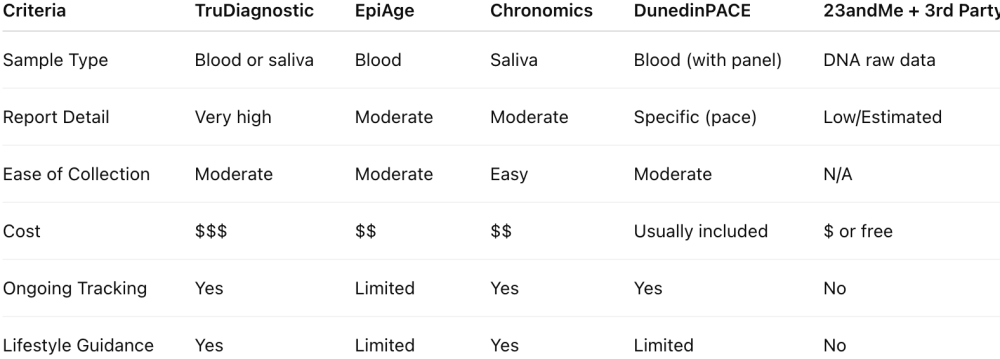
Final Tips Before You Buy
- Think about your goal: If you want detailed insights + ongoing tracking, TruDiagnostic is top-tier.
- If you’re testing once and want something easier, Chronomics is solid and user-friendly.
- Budget-conscious? Consider starting with 23andMe raw data + apps like Aging.ai — but know it’s less precise.
- For clinical or research use, EpiAge or DunedinPACE might be recommended by professionals.
A Deeper Dive on the Options!
1. TruDiagnostic (TruAge)
What it is:
A leading direct-to-consumer epigenetic testing company specializing in detailed DNA methylation analysis from blood or saliva samples. Backed by extensive research and partnerships with academic institutions.
Key Features:
- Biological age, pace of aging, inflammation, and immune markers.
- Detailed reports with scientific explanations and lifestyle suggestions.
- Option for follow-up tests to track changes over time.
- Integration with wellness programs for personalized coaching.
Pros:
- Most comprehensive and research-validated on this list.
- Frequent updates as epigenetics science evolves.
- Supports longitudinal tracking — great if you want to biohack seriously.
Cons:
- Higher cost ($300-$400+ per test).
- Blood draw recommended for best accuracy, which might require visiting a lab or a phlebotomist.
- Data can be dense and complex if you’re new to this.
Ideal for:
People serious about deep longevity insights and who want detailed, actionable data over time.
2. EpiAge
What it is:
An early entrant into epigenetic age testing, often accessed through clinical labs or research partners. Primarily uses blood samples to calculate biological and methylation age.
Key Features:
- Biological age measurement based on methylation markers.
- Often used in research or clinical contexts.
Pros:
- Accurate biological age calculation.
- Used in academic and medical research settings.
Cons:
- Less consumer-friendly interface and fewer lifestyle recommendations.
- Usually requires lab visit for blood draw.
- Limited direct-to-consumer marketing and support.
Ideal for:
Those who want solid, clinically backed biological age testing and don’t need detailed consumer-facing guidance.
3. Chronomics
What it is:
A UK-based epigenetic testing company offering at-home saliva collection kits. Combines epigenetic data with lifestyle questionnaires for a holistic picture.
Key Features:
- Biological age estimation.
- Wellness markers tied to lifestyle factors (e.g., inflammation, stress).
- User-friendly online dashboard with ongoing updates and personalized insights.
Pros:
- Easy, non-invasive saliva test you can do at home.
- Integrates lifestyle data with biology for personalized feedback.
- More affordable (~£150-£200).
- Modern, intuitive digital experience.
Cons:
- Less detailed than TruDiagnostic.
- Primarily UK-focused; international shipping may vary.
- Biological age estimates can be less granular.
Ideal for:
Users looking for an accessible, easy-to-use test with actionable wellness insights.
4. DunedinPACE
What it is:
Not a standalone consumer test, but a cutting-edge biomarker measuring the pace at which your body is aging. Often included as part of larger test panels (e.g., TruDiagnostic).
Key Features:
- Dynamic measure reflecting current speed of aging, sensitive to short-term changes.
- Helpful for tracking intervention effects.
Pros:
- Very sensitive to lifestyle changes — great for biohackers.
- Supported by strong scientific research (Dunedin Study).
Cons:
- Usually bundled with other tests, not sold separately.
- Interpretation can be complex without expert guidance.
Ideal for:
People who want to track how fast they’re aging right now and adjust lifestyle accordingly.
5. 23andMe + Third-Party Analysis
What it is:
23andMe provides genetic data (your fixed DNA code) but not epigenetic testing. You can upload raw data to some apps (like Aging.AI or EpiAge) that attempt to estimate biological age from genetic variants.
Key Features:
- No methylation analysis, so not true epigenetic testing.
- Estimates based on correlations and predictive models.
Pros:
- Very affordable or free if you already have 23andMe data.
- Fast and easy to do.
Cons:
- Not a true epigenetic test — lacks methylation data.
- Results are broad estimates, less actionable or precise.
- Not suitable for tracking lifestyle changes over time.
Ideal for:
Those curious to dip a toe in genetic age estimation without spending much.
Summary Table for Quick Comparison
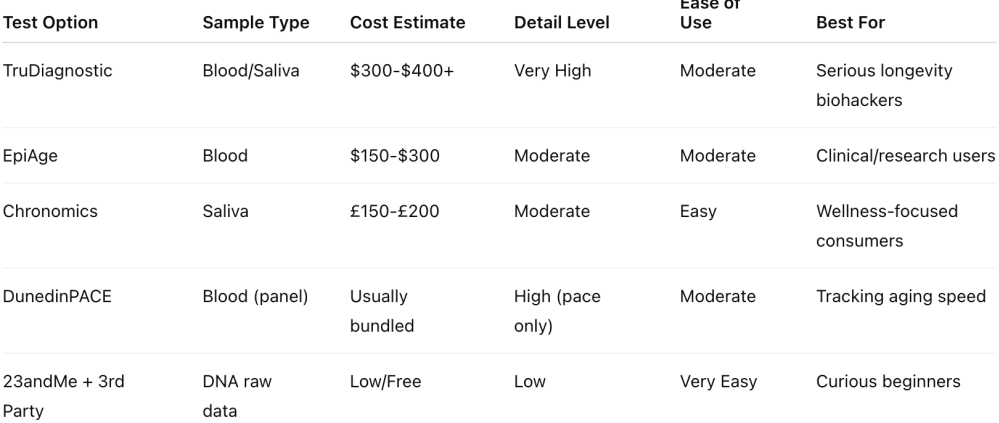
Here’s a handy starter pack to help you confidently order your epigenetic test and nail the sample collection — plus some smart questions to ask the company so you get exactly what you need.
🔗 Ordering & Preparation Guide for Epigenetic Testing
Step 1: Choose Your Test & Order
- Visit the official site of your chosen company:
- TruDiagnostic
- Chronomics
- For EpiAge, you might need to check with clinical labs or your healthcare provider.
- Look for starter kits or testing packages (some offer discounted retests).
- Check shipping options and delivery times for your location.
Step 2: Prepare for Sample Collection
- For blood tests:
- Confirm if you need to visit a lab or if a mobile phlebotomist can come to you.
- Avoid heavy exercise, alcohol, or unusual foods 24 hours before.
- Stay hydrated.
- For saliva tests:
- Don’t eat, drink (except water), smoke, or brush teeth 30-60 minutes before collecting.
- Collect in the morning if possible for consistency.
- Follow instructions carefully to avoid contamination.
Step 3: Ship Your Sample Back
- Use the prepaid shipping label if provided.
- Ensure packaging is secure and samples are sent promptly.
🤔 Smart Questions to Ask Before Buying
- What sample type do you require, and how should I prepare for it?
- How long does it take to receive results?
- What kind of data and reports do you provide?
- Is there ongoing support or coaching included or available?
- Can I retest to track progress, and is there a discount for follow-ups?
- How is my data stored and protected?
- What is your refund or customer satisfaction policy?
- Do you offer guidance on interpreting the results?
Bonus Tip: Keep a Testing Journal
- Note your habits, diet, stress, and sleep patterns the week before testing.
- This gives you context to interpret results and track changes later.